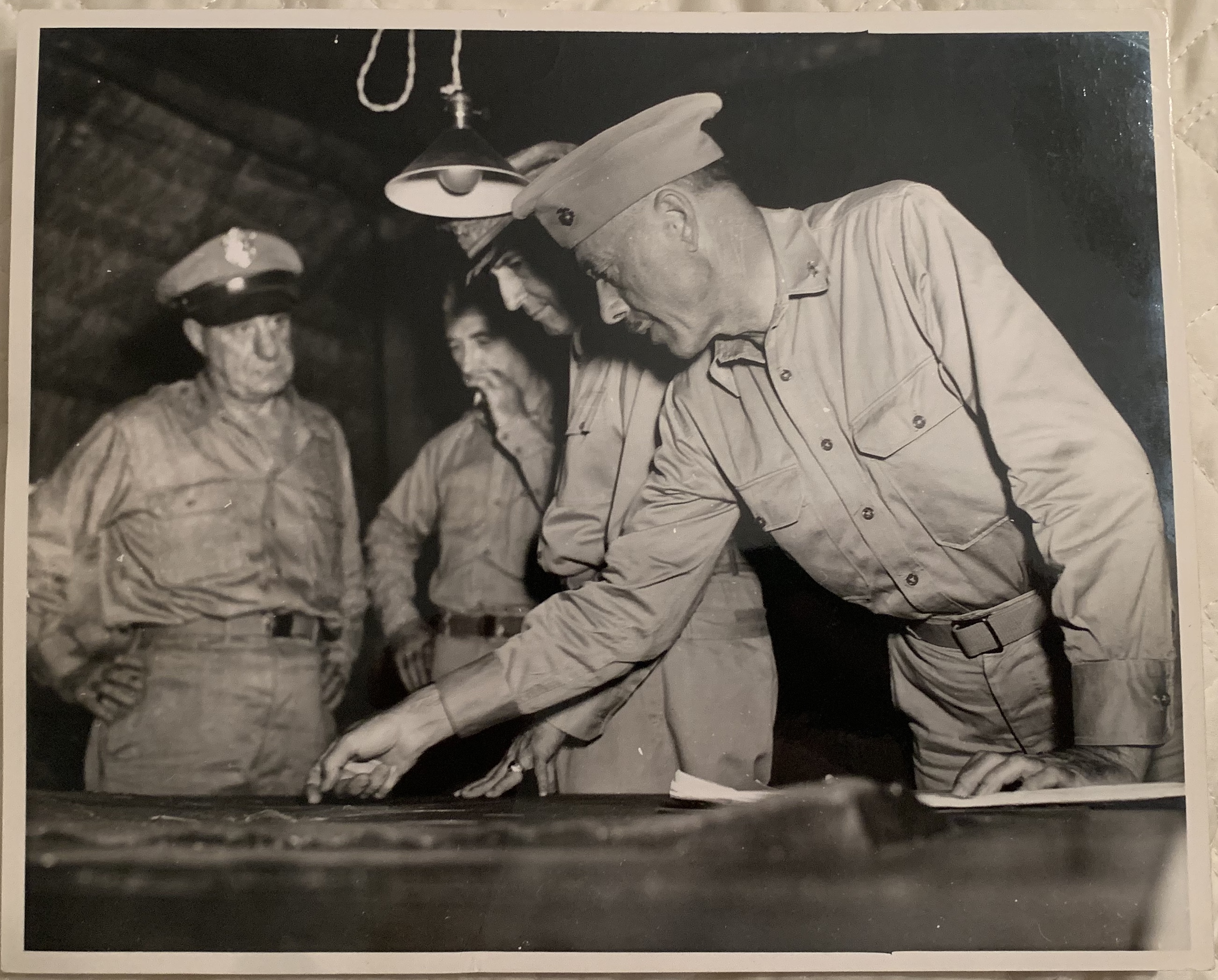
Major General Rupertus, commanding general of a Marine division (right) points out a spot on the map for General Douglass MacArthur, supreme commander of Allied Forces in the Southwest Pacific as Major General Chamberlin (left) and Lt. Walter Krueger look on during a conference at which plans for an offensive against the Japanese were discussed.”
This Memorial Day, I can’t help but think of over 645,000 Americans who lost their lives in service to our country since WWI. Truly humbling.
After researching our grandfather and the 1stMarDiv in WWII Pacific, my mind also turned to that time.
And the astounding numbers of casualties it took to end the war in the Pacific. Which would put an end to WWII.
As our grandfather said in a CBS radio interview on November 11, 1944, almost a year after this photo, WWII was still raging, “The closer we get to the Japanese homeland, the tougher it will get.”
After two and a half years of fighting in the Pacific, it was asked after Peleliu, then Iwo Jima, and Okinawa. How could an enemy that would not surrender finally be defeated?
It would take unrelenting force and persistence.
Allied leaders proposed ideas as to how Japan might surrender “unconditionally,” as President Roosevelt had championed.
Those involved in the Manhattan Project, which built the atomic bomb, saw the nuclear bomb as the answer. Others polled thought a military operation on Japan was an ideal means to provoke a surrender- before bombs dropped.
Nevertheless, all agreed that something must be done to halt the death and destruction on land, air, and sea. If the war continued with Japan, it was estimated it would last another year longer and have 60 to 100% casualties, with over 100,000 American military killed, wounded, or missing in action.
Again, as General Rupertus said, the closer we get to Japan, the fiercer the fighting. There were jaw-dropping casualties as we moved from Peleliu to Iwo Jima to Okinawa.
On Peleliu and Angaur, the cost was high as the Japanese dug in. On Peleliu, the 1st Marine Division casualties were 5450 wounded and 1336 killed. The U.S. Navy had 185 killed. The Army’s 81st Infantry Division had 1,293 casualties and 208 killed. On Angaur, the 81st Infantry had 1676 casualties, with 196 killed in action.
All 10,900 Japanese on Peleliu were killed or committed suicide. 301 were taken as prisoners of war.
On Iwo Jima, there were 26,038 American casualties and 6821 US Soldiers, Marines, and Sailors killed (U.S. Navy suffered 934 killed). Of the estimated 21,000 Japanese military, all but 200 were killed or committed suicide.
Then the battle at Okinawa came.
Along with the damage to ships from Kamikaze pilots that contributed to 3809 US Navy deaths, this operation alone caused a stunning, almost unreal number of casualties:
Over 49,000 American casualties (12,000+ killed or missing in action) and an estimated 90,000 Japanese combatants were killed or committed ritual suicide on Okinawa. It is estimated over 100,000 Japanese civilians also died.
Horrific numbers and the worst in the Pacific Theatre.
Yet, despite the defeat and the shocking number of Japanese killed, Japan refused to surrender.
The majority of the allied scientific, military, and government officials agreed something big had to be done quickly to avoid another Okinawa.
Most of those involved in ending the war and bloodshed adhered to one or a combination of three military theories as outlined in the excellent book Sea Power by E.B Potter and Admiral Chester Nimitz:
“For convenience, we may call these the Army Theory, the Navy Theory, and Air Force Theory, provided we understand that none of the three were advocated exclusively by any one service or branch.
The Army Theory supported a full invasion of Japan to stop the fighting and fanaticism.
The Navy Theory was to defeat Japan by the blockade.
The Air Forces Theory was that Japan could be defeated through the continuous bombing of Japan’s cities and or industries.
These theories, combined with the others and the American policy of “unrelenting pressure” on Japanese military and naval power, led the Joint Chiefs of Staff to put into effect all means of defeating the enemy- and all, except the actual invasion of Japan’s home islands, were carried out.”
On August 6 and August 9, 1945, with the support of the new U.S. President Truman and British allies and a nod from the Soviet Union, the U.S. attempted to end the long war with Japan.
Keep in mind that many, including me, really believe this war started with the July 7-9, 1937 Marco Polo Bridge incident and the August 13, 1937, Japanese offensive on Shanghai (which killed an estimated 200,000 Chinese), and the Nanking Massacre (estimated 200,000-300,000 Chinese were killed).
It was time to halt the death and destruction.
On August 6, 1945, an American B-25 bomber dropped the first atomic bomb on Hiroshima, instantly killing almost 70,000.
Still no surrender.
On August 9, the Americans dropped the final atomic bomb on Nagasaki, killing 40,000.
Though word of a Japanese surrender arrived the next day, despite the instant devastation to her citizens, it was not until August 15, 1945, that Emperor Hirohito and the Japanese government and military agreed to the principles of surrender.
Finally, on September 2, 1945, the surrender was made official and signed aboard the battleship U.S.S. Missouri in Tokyo Bay.
This formal surrender took place four months after the war in Europe ended (May 8, 1945) and eight years after the August 13, 1937, Japanese attack on Shanghai.
The Americans and allied forces fought until there “Is no enemy but Peace,” as it says in “My Rifle the Creed of a US Marine.”
World War II officially came to an end.
My prayer is that was the final World War.
References:
Henriot, C. War and Death en masse of Civilians https://www.virtualshanghai.net/Texts/Articles?ID=130
History.com editors. Nanking Massacre https://www.history.com/topics/japan/nanjing-massacre July, 2019.
Potter, E.B and Nimitz, Chester. Sea Power: A Naval History. Prentice-Hall, 1960.
Naval History and Heritage Command. World War II Casualties.
Vergun, David. Remembering the Battle of Okinawa. April 1, 2020. https://www.defense.gov/News/Feature-Stories/story/Article/2130718/remembering-the-battle-of-okinawa/
National WWII Museum authors. Iwo Jima and Okinawa: Death at Japan’s Doorstep. No date was given. https://www.nationalww2museum.org/war/articles/iwo-jima-and-okinawa-death-japans-doorstep
Gayle, Gordon D. Bloody Beaches, The Marines at Peleliu. Marine Corps Historical Center, 1996. https://www.nps.gov/parkhistory/online_books/npswapa/extcontent/usmc/pcn-190-003137-00/sec1.htm
Fries, Carsten. Operation Stalemate II: The Battle of Peleliu 15 September-27 November 1944. Naval History and Heritage Command. January 19, 2020. https://www.history.navy.mil/browse-by-topic/wars-conflicts-and-operations/world-war-ii/1944/peleliu.html
